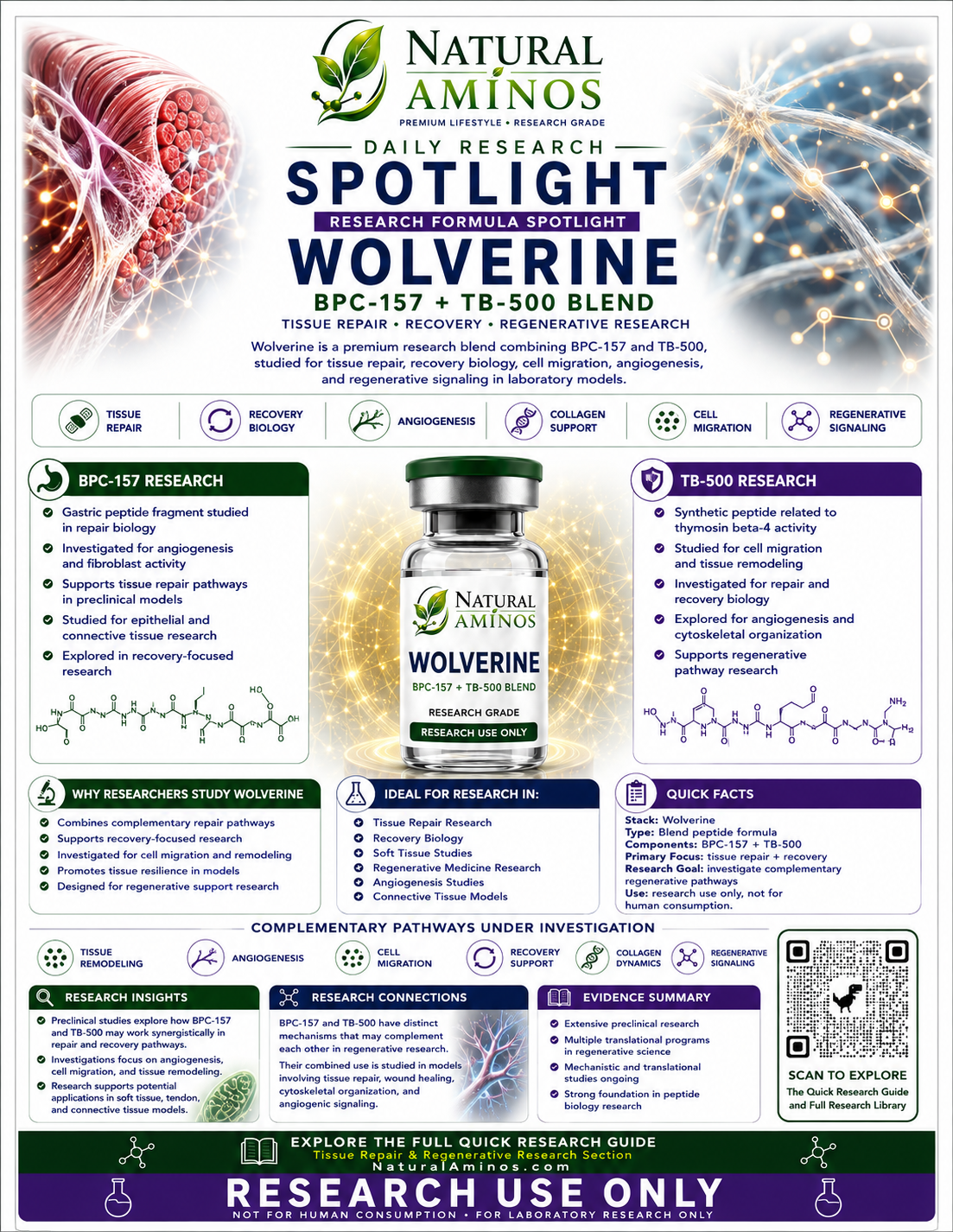
Wolverine Blend Research Data
For laboratory research use only; not for human or veterinary use or consumption. This page provides research information, not personal-use instructions or medical advice.
NATURAL AMINOS RESEARCH
Formula of the Day
The “Wolverine” Stack
BPC-157 & TB-500 — Soft-Tissue Recovery Spotlight
Benefits
“Wolverine” is an informal, internet-coined nickname — not a branded drug or an official combination — for stacking two separate research peptides: BPC-157 and TB-500. There is no standardized formulation, dose, or ratio; it varies by whoever is selling or discussing it. BPC-157 is a 15-amino-acid fragment originally isolated from human gastric juice, studied mainly in rodent models for promoting angiogenesis (new blood vessel growth), modulating nitric oxide signaling, and upregulating local growth-factor activity at injury sites. TB-500 is the peptide-market name for a short synthetic fragment (commonly Ac-LKKTETQ) related to the naturally occurring protein thymosin beta-4, an actin-regulating protein studied for promoting cell migration, angiogenesis, and inflammation resolution.
The theoretical benefit of pairing them is that they're proposed to act on different, complementary stages of tissue repair rather than doing the same thing twice: BPC-157's contribution is framed as more local (growth-factor signaling, blood vessel formation at the injury site) while TB-500's contribution is framed as more systemic (cell migration and mobilization across the whole body). That non-overlap is a genuine, testable mechanistic distinction — but it is a reasoned story built from studying each peptide separately, not a benefit that has been measured for the combination itself.
Uses
The Wolverine stack is marketed and discussed almost entirely for soft-tissue and orthopedic recovery — tendon, ligament, muscle, and joint injuries, plus post-surgical recovery and general “bounce-back” after training or trauma. Some discussion extends to gut-tissue support, though that comes from BPC-157's individual research history, not from anything studied for the pair. Neither peptide is FDA-approved for any indication, and neither is legally marketed for human use: BPC-157 is sold as a research chemical labeled “not for human consumption,” and its regulatory status has been actively unsettled — removed from the FDA's 503A compounding category, with an FDA advisory committee (PCAC) voting on its future status as recently as 2025. “TB-500” as a standalone fragment product occupies a similar unregulated research-chemical space.
Published Research
For BPC-157, the human evidence gap is close to total: a 2025 systematic review found no completed human clinical trials and, by extension, no confirmed human safety data — nearly everything published is rodent research. A handful of very small, low-quality human reports exist outside formal trials (two patients in one case report; a separate small study describing benefit in 7 of 12 subjects with knee pain), but these are far too small and uncontrolled to establish efficacy or safety.
For TB-500, the situation is more specific and easy to misread: the strongest human clinical trial data in this space does not actually belong to the injectable “TB-500” fragment sold in the peptide market — it belongs to the full-length parent molecule, thymosin beta-4, studied as RGN-259 eye drops and RGN-352 injectable formulations by a pharmaceutical developer. RGN-259 has completed Phase 2 and Phase 3 trials for dry eye and neurotrophic keratopathy, with a mixed record: some trials showed significant improvement in corneal healing and comfort, while others missed their primary endpoints and only showed benefit on secondary measures. A 2025 randomized trial of injectable thymosin beta-4 in 96 heart attack patients found no significant overall reduction in infarct size, though a subgroup treated very early after their procedure did show benefit. None of this trial program tested TB-500 the fragment, and none of it tested tendon, ligament, or muscle repair — the exact use case the Wolverine stack is marketed for. No published research has evaluated BPC-157 and TB-500 together, in any combination, for any outcome.
Why More Research Is Needed
What's actually proven: essentially nothing about this specific stack, for this specific use, in humans. BPC-157 has zero completed human trials of any kind. TB-500's closest human evidence belongs to a different molecule (full-length thymosin beta-4) tested for different indications (dry eye, neurotrophic keratopathy, cardiac tissue after a heart attack) — not for the soft-tissue injury recovery the stack is sold for, and with a genuinely mixed trial record even in those tested indications.
The theory behind stacking them: the appeal rests on a plausible, non-overlapping-mechanism story — one peptide contributing local vascular/growth-factor signaling, the other contributing broader cell-migration and anti-inflammatory activity. That kind of complementary-pathway reasoning has held up reasonably well for other stacks in this series. Here it's weaker on its own terms, because even the individual mechanistic case rests heavily on rodent data (BPC-157) and on a different, related-but-distinct molecule (TB-500's full-length parent) rather than on the actual marketed compound itself.
Where the theory is weaker in practice: ‘plausible complementary mechanism’ is doing almost all of the work here, because there is no human trial — for either peptide individually, let alone the pair — that has tested the injury types (tendon, ligament, muscle) the stack is actually marketed for. This is a materially thinner evidence position than other stacks reviewed in this series, where at least one component had direct, on-target human trial data.
Verdict — theory vs. proof: the mechanistic theory for combining these two peptides is coherent but built almost entirely on animal data and on a different, related molecule rather than on the compounds actually being sold and used. There is no proof — human trial, case series, or otherwise — for the Wolverine stack's marketed use in soft-tissue recovery. This should be read as an unstudied combination of an unstudied peptide (BPC-157) and a repurposed name borrowed from a differently-tested molecule (TB-500/thymosin beta-4), not as two proven treatments layered together.
Sources
• Vasireddi et al. (2025) — Systematic Review: No Completed Human Clinical Trials or Confirmed Human Safety Data for BPC-157
• BPC-157 as an Investigational Peptide Therapeutic: Biopharmaceutical Challenges, Formulation Strategies, and Translational Development Barriers
• Sosne, Dunn & Kim (2015) — Phase II RCT of Thymosin Beta-4 (RGN-259) 0.1% for Dry Eye, Cornea
• Sosne & Ousler (2015) — Phase II Double-Masked Placebo-Controlled Trial of Tβ4 (RGN-259) in the Controlled Adverse Environment Dry Eye Model, Clinical Ophthalmology
• Sosne et al. (2022/2023) — Phase III RCT of RGN-259 for Neurotrophic Keratopathy, International Journal of Molecular Sciences
• Zhang et al. (2025) — Human RCT of Recombinant Thymosin Beta-4 in Acute ST-Elevation Myocardial Infarction, Cardiovascular Research
• FDA Pharmacy Compounding Advisory Committee (PCAC) — 2025 Vote on BPC-157 and Related Peptides for Compounding Eligibility
Hashtags
#Peptidetherapy #PeptideResearch #PeptideScience #Biohacking #ResearchPeptides #ScienceBased #BPC157 #TB500 #WolverineStack #TissueRepair #RecoveryScience
This material is for research and educational purposes only and is not medical advice. Neither BPC-157 nor TB-500 is FDA-approved, and neither has completed human trials for the injury types this stack is marketed to treat.